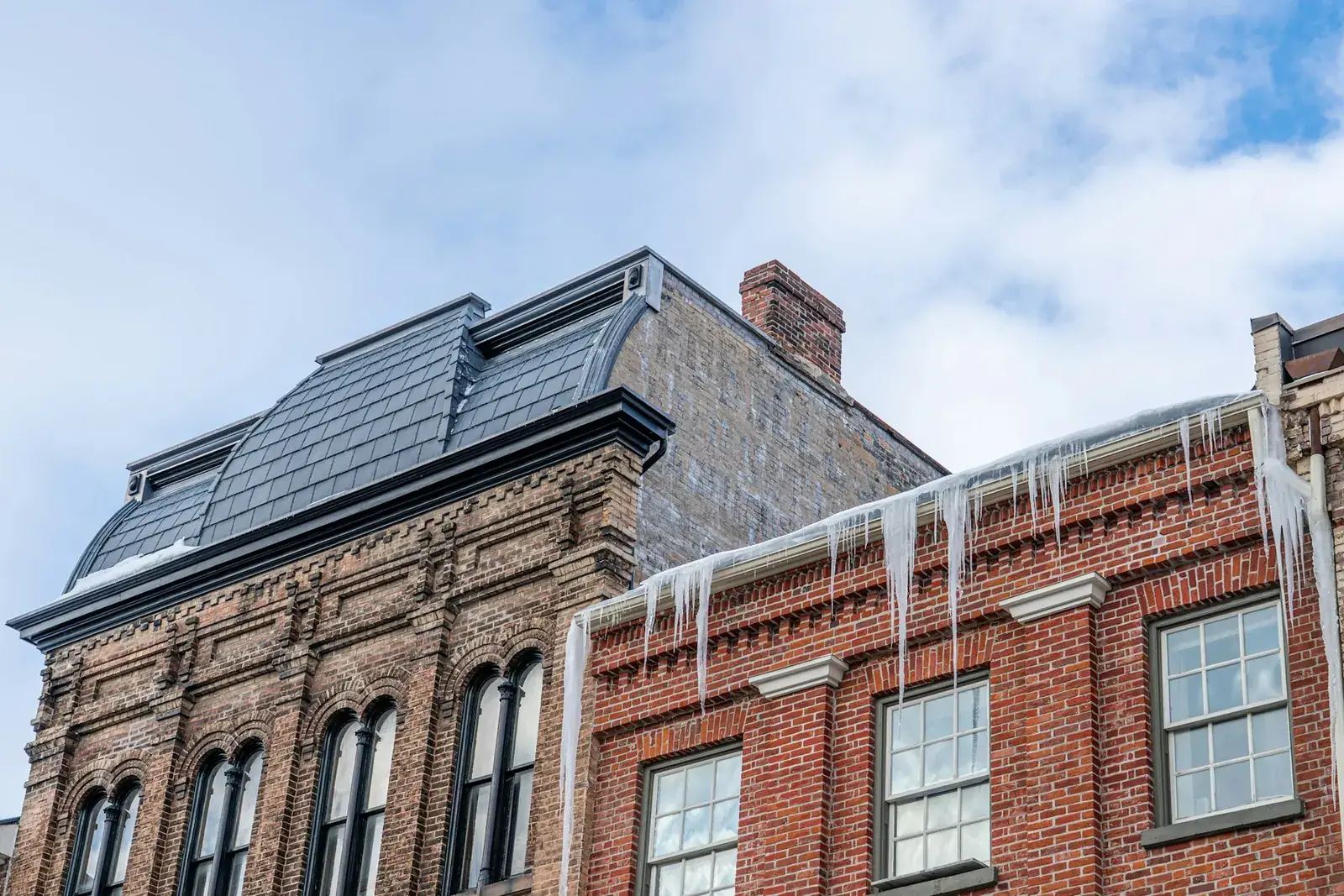
Is the winter leak in my ceiling an ice dam or the chimney?
Look at where the water shows up. An ice dam leak appears along the outside walls under the eaves, where melted snow refreezes. A chimney leak appears around the chimney itself, often after any thaw or rain, through the crown, cap, flashing or brick. The University of Minnesota Extension notes that fireplace use can help cause ice dams, so sometimes it is both.
Minneapolis Fireplace & Chimney · November 6, 2026
How ice dams form
The University of Minnesota Extension explains ice dams as a temperature problem. Heat escaping from the house warms parts of the roof, the snow there melts, and the water runs down to the cold overhang at the eave, where it freezes again. The ridge of ice grows, water pools behind it, and that water works its way under the shingles and into the wall or ceiling.
Extension names chimneys directly: frequent use of wood stoves and fireplaces can let heat move from the chimney into the attic. Its recommended fix starts with making the ceiling airtight, then adding insulation. It also says mechanical attic ventilation is not a recommended solution to ice dams in Minnesota, and that raking snow off the roof removes one ingredient but can damage roofing.
The Twin Cities give ice dams plenty of material. NOAA's 1991–2020 normals for the MSP airport show about 51 inches of snow a year and about 90 days with at least an inch on the ground.
How chimney leaks behave
A chimney is a tall masonry box that passes through the roof. Water gets in at the top or at the roof line, and it can travel down inside the stack before it shows up, sometimes in an upstairs closet, sometimes in the basement. Unlike an ice dam, a chimney leak does not need a pile of snow; it shows up during spring rain and autumn storms too.
- Crown: a cracked mortar top lets water straight into the masonry. The current Minnesota Residential Code (IRC R1003.9.1) calls for a sloped concrete, metal or stone cap with a drip edge.
- Cap: an open flue with no cap collects rain and snow directly.
- Flashing: the metal seal where the chimney meets the shingles loosens over time, and caulk alone does not last.
- Cricket: a chimney wider than 30 inches along the ridge needs a small peaked roof behind it to shed water (IRC R1003.20). Without one, snow and water collect against the chimney.
- Brick and mortar: open joints and porous brick soak up water that later drips inside.
Reading the stain
Ask three questions. Where is it? Stains in a band along an exterior wall, under the eaves and away from the chimney point to an ice dam. Stains on the ceiling or wall right next to the chimney, or in a room the chimney runs through, point to the chimney.
When does it appear? A leak that only shows up during a midwinter thaw with heavy ice on the gutters is most likely an ice dam. A leak that shows up during a summer storm is not an ice dam.
What does the roof look like? Icicles and thick ice along the eaves are the visible sign of a dam. A chimney with green or white stains on the brick, a broken crown or bent flashing is a likely leak source. If both are true, the warm chimney may be helping melt snow above it, and both problems need attention.
What repairs cost
For the chimney side, we print ranges drawn from national cost data. A straightforward leak repair runs $150–$500. Crown crack repair runs $200–$700+, and flashing repair or replacement runs $300–$1,800. A cricket behind a wide chimney is priced at the inspection, since it depends on the roof.
For the ice dam side, Extension's advice is to seal air leaks in the ceiling and then improve insulation. Air sealing around the chimney where it passes through the attic is a common part of that work, and it should be done with materials rated for the heat near a chimney, not loose fiberglass stuffed into the gap.
Getting the right answer
Our inspection is free. We look at the chimney from the roof, check the crown, cap, flashing and brick, and look for staining in the attic and the rooms below. If the leak is coming from the roof and not the chimney, we will tell you that. You get photos and a written price before any work.
FAQ
More answers
Can a chimney leak cause an ice dam?
Not directly, but a warm chimney can. University of Minnesota Extension notes that fireplace and wood stove use can let heat from the chimney into the attic, which melts snow above that part of the roof.
Should I seal my chimney with a waterproofing spray?
Only after the crown, cap and flashing are sound. A breathable water repellent helps porous brick shed water and typically runs $150–$820+. It will not stop a leak from a cracked crown or loose flashing.
Is it safe to use the fireplace while the chimney leaks?
Water in the chimney can damage the flue lining and the firebox. Have it looked at before the next fire, especially if you see rust on the damper or wet masonry inside the fireplace.
Keep reading
More from the blog
 Does Minnesota require a metal liner for a gas furnace or water heater in a brick chimney?What Minn. R. 1346.5501 says about metal liners in brick chimneys that vent a gas furnace or water heater, which liners qualify, and what relining costs.
 What happens to the water heater when a new furnace stops using the chimney?A new side-vented furnace can leave the water heater alone in an oversized brick flue. What IFGC 501.15 says about resizing, and how the fix works in Twin Cities homes.
 How does Minnesota's freeze-thaw cycle damage a chimney crown?Why the concrete crown on top of a brick chimney in the metro cracks, how often MSP swings across freezing, and when to repair or replace.
Book online
Choose a day. We'll bring the ladder.
Free inspection in a 3-hour arrival window: 8 to 11, 11 to 2, or 2 to 5, Sunday through Friday. We phone to confirm before we come.