Chimney and fireplace work in St. Paul
Four in ten St. Paul homes were standing before 1940, and the city asks for a permit for any tuckpointing inside a Historic Preservation Area. We start with a free inspection, photos and a written price.
St. Paul's housing is nearly as old as its neighbor across the river. The 2024 American Community Survey puts 41.6 percent of the city's 133,051 housing units in the 1939-or-earlier column, about 55,000 homes, with another 17.7 percent from 1940 to 1959 and a median year built of 1952. Natural gas heats 66.9 percent of occupied homes and electricity most of the rest, so a brick chimney here is usually a furnace or boiler flue first and a fireplace second.
The nearest NOAA station, on the University of Minnesota's St. Paul campus, logs about 152 nights a year at or below freezing and about 24 nights at or below zero in its 1991–2020 normals, a little colder than the airport. That works out to roughly 78 days a year that freeze and thaw, by our arithmetic. We inspect free of charge: roof, crown, flashing, every flue and the firebox, with photos and a written price for anything we find.
Historic Hill, Summit Avenue and the permit rule
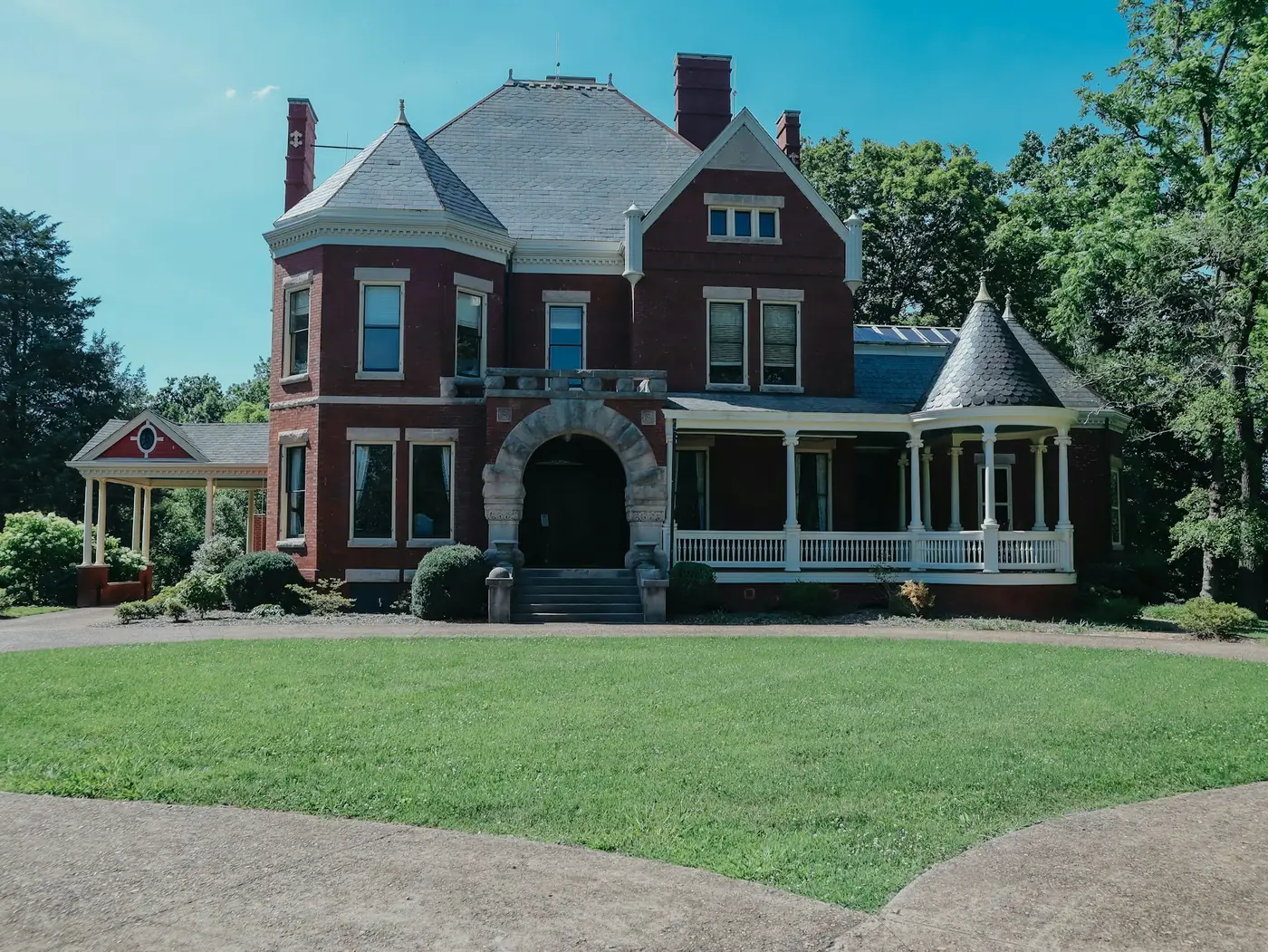
The Historic Hill District joined the National Register on August 13, 1976. It covers an irregular area roughly between Lexington Avenue, Dale Street, Portland and Marshall avenues, Pleasant Street and Grand Avenue, built from about 1860, and most of the Ramsey Hill houses inside it date from 1890 to 1920. Farther west, the West Summit Avenue Historic District, listed in 1993, follows the avenue from Lexington Parkway to Mississippi River Boulevard with Queen Anne, Romanesque Revival, Tudor Revival and Craftsman houses, many with tall, corbeled chimneys.
St. Paul's Department of Safety and Inspections says that in a Historic Preservation Area a permit is required for exterior repairs such as tuckpointing, no matter what the job costs. Heritage Preservation staff take questions at 651-266-9078. We check your address against the preservation areas before quoting, and we help you prepare the photos and a written scope, including a mortar that matches the original color, texture and joint profile.
- Tuckpointing with matched mortar: $500 to $2,500
- Spalled brick replaced: $1,000 to $3,500
- Partial rebuild of the top of the stack: $1,000 to $5,000+
Gas flues, boilers and the water heater left behind
On the older grids of West Seventh, Dayton's Bluff and Hamline-Midway, the chimney that once served a coal furnace often still vents whatever gas appliance replaced it. Minnesota's fuel gas rules (Minn. R. 1346.5501) call for an approved metal liner in any masonry chimney that vents a gas appliance and forbid tying an appliance into a fireplace flue. When a new furnace vents out the side of the house, IFGC 501.15 says the chimney left behind must be resized to control condensation.
An aluminum gas liner typically costs $625 to $2,250 and a stainless liner $900 to $3,800. Separately, the city treats a factory-built fireplace or a freestanding wood stove as mechanical-permit work; the mechanical inspection line is 651-266-9004. We check what your project needs before we start.
Ice dams or a leaking chimney
With 6.3 percent of St. Paul units in two-unit buildings and a housing stock this old, winter leaks are common and easy to misread. The University of Minnesota Extension explains that ice dams form when uneven roof temperatures melt snow that refreezes at the cold eave, and it names frequent fireplace and wood stove use as one way heat reaches the attic. Its first fix is an airtight ceiling, not more attic fans.
A stain that appears beside the chimney during any thaw usually points to the flashing or crown. One that shows up only along the eaves after a hard freeze points to an ice dam. At the free inspection we look at both. Leak repair typically runs $150 to $500, and new flashing $300 to $1,800, with a cricket behind any chimney wider than 30 inches along the ridge, as the current Minnesota Residential Code describes.
Where we work in St. Paul
Summit Hill · Summit-University · Macalester-Groveland · Highland Park · Union Park · Saint Anthony Park · Como Park · Hamline-Midway · West Seventh · Dayton's Bluff · Payne-Phalen · Thomas Dale (Frogtown) · North End · West Side · Greater East Side
FAQ
St. Paul chimney questions
Do I need a permit to tuckpoint my chimney in St. Paul?
If the house is in a Historic Preservation Area, yes. The city's Department of Safety and Inspections says exterior repairs such as tuckpointing need a permit there regardless of cost. Outside those areas the rules depend on the size of the job. We check your address before quoting and tell you what the city requires.
Can a wood stove go into the old fireplace chimney?
Often, with a stainless liner run from the stove to the top. St. Paul treats a freestanding wood stove as mechanical-permit work. Installing a stove into an existing masonry chimney typically runs $4,000 to $8,000, and we start by checking the chimney's condition at a free inspection.
Who has to have carbon monoxide alarms in a St. Paul duplex?
Minnesota law (Minn. Stat. 299F.51) requires a working CO alarm within 10 feet of every room used for sleeping in every dwelling unit. In multifamily buildings the owner installs and replaces missing alarms, and occupants keep them working.
I smell gas near the fireplace. What should I do?
Leave the house, then call 911 and your gas utility from outside. Don't flip switches or try to relight anything. Once the utility has made it safe, we can look at the fireplace valve, pilot and venting.
Book online
Book in St. Paul. The inspection is free.
Free inspection in a 3-hour arrival window: 8 to 11, 11 to 2, or 2 to 5, Sunday through Friday. We phone to confirm before we come.